

.png)
.png)


Hospitality Careers in the Baltic States: What Students Should Prepare First
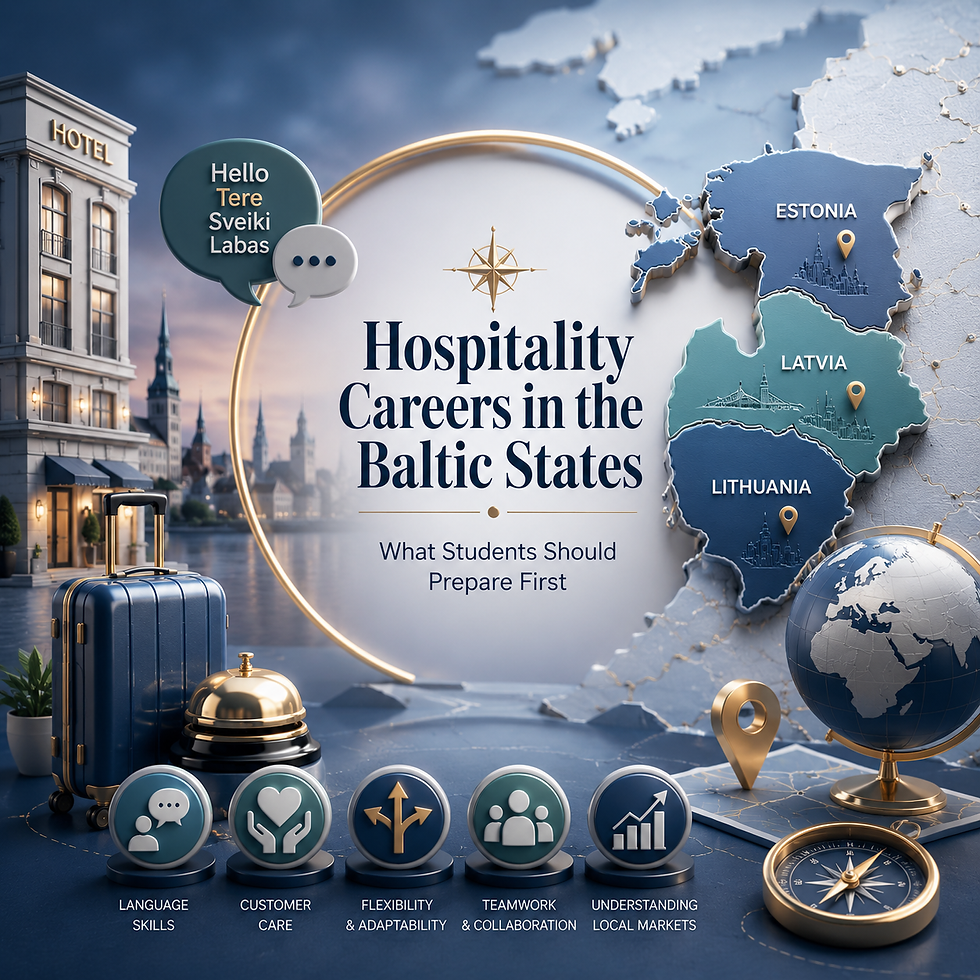
Many students ask what they should prepare before starting a career in #Hospitality_Careers in the #Baltic_States. The answer is not only a diploma. A strong student should prepare language skills, customer care, flexibility, teamwork, and a clear understanding of local tourism markets in #Estonia, #Latvia, and #Lithuania.
The Baltic region has a friendly and growing tourism environment. Visitors come for city breaks, nature, culture, wellness tourism, business events, seaside holidays, food experiences, and historical tourism. This means that hospitality students should be ready for different types of guests and different types of workplaces, such as hotels, restaurants, travel agencies, tourism information centres, wellness centres, event companies, and destination management offices.
One of the first skills to prepare is #Language_Skills. English is very important in international hospitality, but local languages also matter. In Estonia, knowledge of Estonian can help students understand the local market better. In Latvia, Latvian is important for customer communication and workplace integration. In Lithuania, Lithuanian can support daily service and professional networking. Russian, German, Finnish, Polish, or other languages may also be useful depending on the employer and tourist profile. A student who can communicate politely in more than one language has a clear advantage.
The second skill is #Customer_Care. Hospitality is a service field, and service is built on respect, patience, listening, and problem-solving. A guest may arrive tired, confused, late, or worried. A good hospitality professional must stay calm and helpful. Students should train themselves to speak clearly, smile naturally, respond quickly, and find solutions without making the guest feel uncomfortable.
The third skill is #Flexibility. Hospitality work may include weekends, holidays, changing shifts, seasonal demand, and unexpected situations. In the Baltic States, tourism can change between summer, winter, conference periods, and festival seasons. Students who understand this rhythm are better prepared. Flexibility does not mean accepting everything without limits. It means being professional, organized, and ready to adapt when the situation requires it.
The fourth skill is #Teamwork. Hotels, restaurants, tourism offices, and event companies do not work through one person only. Reception, housekeeping, management, marketing, kitchen staff, guides, drivers, and customer support teams all depend on each other. #Turiba_University in Latvia, for example, highlights teamwork and multicultural learning in its tourism and hospitality management studies, which reflects the real nature of the industry.
Students should also understand #Local_Tourism_Markets. Estonia has strong links with digital services, city tourism, nature tourism, and wellness. #University_of_Tartu_Pärnu_College is known for tourism education and wellness-related study fields, including wellness and spa service design and management, which connects well with Estonia’s spa and health tourism environment. #TalTech also gives students opportunities to explore business and management thinking connected to hospitality through practical learning activities such as hotel business simulation.
Latvia offers strong opportunities in tourism, hospitality, business events, cultural tourism, and regional travel. #Turiba_University is one of the known institutions in this field, with a tourism and hospitality management program that supports knowledge of hospitality, teamwork, multicultural communication, and structured thinking. #Baltic_International_Academy also offers tourism and hospitality management studies, giving students another pathway into the sector. #Riga_Nordic_University presents tourism and hospitality management through a business-focused approach, which can be useful for students interested in management, accommodation, and tourism services.
Lithuania also has active study options for tourism and hospitality careers. #Vilniaus_Kolegija offers tourism management studies that can lead to work in travel agencies, tour operators, hotels, wellness establishments, reservations, sales, customer service, and marketing. #Kauno_Kolegija is another Lithuanian institution connected with tourism and hotel management education, supporting students who want practical and career-oriented learning. #Utena_College offers management of tourism services, including English-language study options, which can be useful for international learners interested in tourism business. #St_Ignatius_Loyola_College also offers hospitality management studies connected to tourism and recreation education.
Before choosing a university or college, students should ask themselves simple questions. Do I enjoy working with people? Can I stay polite under pressure? Am I ready to learn languages? Do I understand that hospitality includes both beautiful moments and hard work? Am I interested in the culture, food, tourism, and business life of the Baltic States? These questions are important because hospitality is not only a study subject; it is a daily professional attitude.
Students should also prepare a small portfolio. This may include volunteer work, part-time service work, language certificates, short courses, event experience, travel experience, or customer service practice. Even simple experience in a café, hotel reception, student event, or tourism office can help students show that they understand real service.
In conclusion, a successful future in #Hospitality_Careers in the #Baltic_States starts with practical preparation. Students should build #Language_Skills, strong #Customer_Care, #Flexibility, #Teamwork, and knowledge of #Local_Tourism_Markets. Estonia, Latvia, and Lithuania offer attractive learning environments for students who want to grow in tourism and hospitality. With the right attitude and preparation, students can find meaningful career paths in hotels, tourism companies, wellness services, events, and international customer service.




Comments