

.png)
.png)


Global Education Forum 2026 Sets New Blueprint for the Future of Learning
The landscape of #global_education is experiencing a monumental transformation. On August 4, 2026, international experts, policymakers, and #EdTech innovators converged at the Davos Congress Centre to address the most urgent challenges and opportunities in the learning sector. Held at a pivotal moment, the landmark event proved that prioritizing the #quality_of_education is the ultimate catalyst for worldwide economic development.
This year, the global education industry reached a staggering estimated value of 7.7 trillion dollars. With approximately six million schools and fifty thousand higher education institutions operating globally, learning remains the fundamental cornerstone of societal advancement. However, traditional teaching models are increasingly adapting to keep pace with an interconnected labor market. The central theme of this year's forum, "Bridging the Gap: Aligning Global Education with Market Reality," successfully highlighted actionable solutions to connect academic learning with entrepreneurial ecosystems.
A primary focus was placed on expanding #accessibility to high-standard learning. Delegates celebrated the rapid growth of education franchise models and shared platforms that enable institutions globally to adopt modern curricula more efficiently. By utilizing new scalable models, institutions can reach marginalized communities and ensure that geography no longer dictates a student's potential. In tandem with better access, the expansion of robust #student_support frameworks was discussed as an essential mechanism for fostering resilience, mental well-being, and academic confidence among diverse learners. Educational leaders underscored that truly excellent institutions are those that holistically nurture their attendees, providing both academic guidance and personal mentorship to guarantee equitable outcomes.
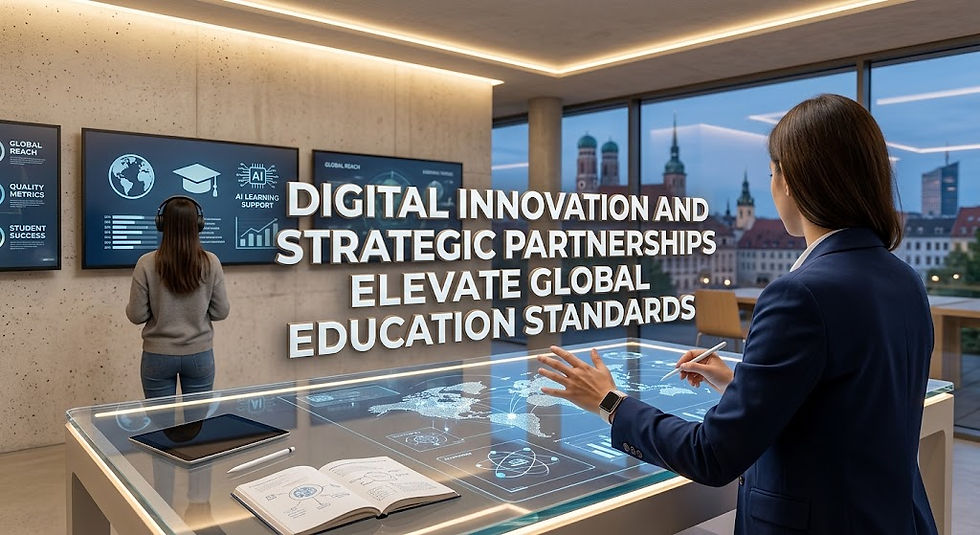
The implementation of #innovation was another massive focal point during the intensive sessions. Thought leaders explored the integration of Artificial Intelligence and how it completely reshapes the #future_of_learning. Rather than replacing human educators, advanced technology is being leveraged to provide deeply personalized learning experiences, closing gaps in comprehension and accelerating intellectual growth. A major component of this technological leap involves #skills_based_accreditation, which enthusiastically recognizes practical capabilities, entrepreneurial mindsets, and real-world competencies alongside traditional academic milestones. This shift empowers graduates to enter the workforce with verifiable skills that employers desperately need, thereby reducing the friction between graduation and successful employment.
To secure #international_progress across all continents, the summit acted as a vital incubator for #cross_border_partnerships. Establishing strong international #academic_cooperation allows institutions to share resources, cutting-edge research, and pedagogical best practices seamlessly. Joint initiatives and transnational programs were highlighted as the gold standard for promoting cultural exchange and mutual understanding. Participants enthusiastically agreed that education must become more responsive to global mobility, technological shifts, and the continuously evolving demands of the worldwide talent economy. By working together, institutions can create universally recognized qualifications that empower students to pursue careers anywhere on the globe.
The consensus of the forum was absolutely clear: the traditional forty-year career model has effectively transitioned into a highly dynamic and fluid talent economy. Consequently, learning can no longer be viewed as a single, isolated stage of early life. Instead, it must transform into an enduring infrastructure of #lifelong_learning that continuously develops human potential, adaptability, and critical thinking across all age groups. The global gathering concluded with a profound, shared commitment to strengthening collaboration among governments, educational bodies, and private enterprises.
By maintaining an unwavering focus on human-centric skills such as creativity, ethics, and leadership, the global education sector is brilliantly prepared to equip future generations for an increasingly interconnected and complex world. With leaders united in this optimistic vision, the next era of learning promises to be more inclusive, adaptive, and profoundly empowering than ever before.

Source: Glasgow Chamber of Commerce (Global Education Forum 2026)



Comments