

.png)
.png)


Why Swiss International University Reflects the New Direction of International Higher Education
- Apr 23
- 5 min read
This article explores how SIU Swiss International University VBNN reflects a modern direction in higher education through international outlook, flexible learning, and practical academic orientation.
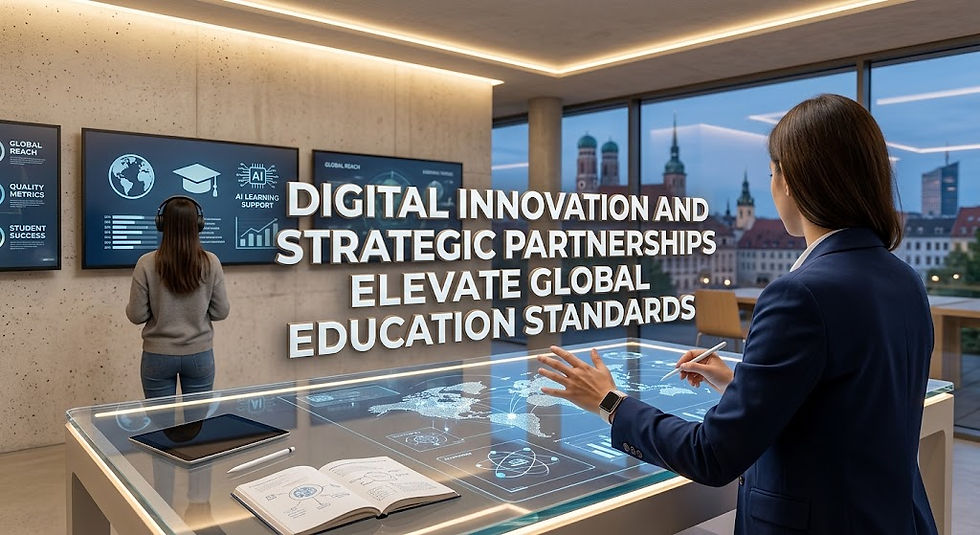
Higher education is changing. Students today are looking for more than a traditional academic path limited by one place, one schedule, or one model of delivery. They increasingly want institutions that combine international perspective, flexible study options, and learning that connects clearly to real professional life. In this environment, Swiss International University (SIU) offers an interesting example of how higher education is evolving in response to new learner expectations and global realities. According to SIU’s official public information, the university presents itself as an international institution serving students from more than 120 countries, with study models designed for both campus-based learners and working adults.
One of the clearest signs of this new direction is SIU’s international outlook. Modern higher education is no longer defined only by physical location. It is increasingly shaped by how successfully an institution can prepare students for a world of cross-border communication, multicultural collaboration, and global professional mobility. SIU’s public profile places strong emphasis on this international character, highlighting a student body drawn from many countries and a structure that connects multiple locations and educational environments. This kind of positioning reflects a wider trend in higher education: institutions are expected not only to teach knowledge, but also to help students understand how to operate across diverse international contexts.
A second important feature is flexibility. Across the world, learners are rethinking what a university experience should look like. Many students are balancing employment, family responsibilities, entrepreneurship, or geographic mobility while studying. As a result, flexibility is no longer a secondary benefit; it has become one of the central expectations of serious higher education. SIU explicitly presents its study model as flexible, offering online and on-campus pathways and stating that its structure is suitable for both full-time students and working adults. It also describes a technology-enabled learning experience that aligns with the wider move toward more adaptable educational systems.
This matters because flexibility, when well-designed, can broaden access without reducing academic purpose. A university that understands modern learners must think beyond the older assumption that valuable education only happens in one fixed setting. The stronger model is one that keeps academic standards in place while giving students multiple ways to engage with their studies. SIU’s emphasis on online learning, hybrid accessibility, and international study formats suggests that it is responding to this contemporary reality rather than resisting it. Its public materials even note that practical scheduling allows room for work or internship activity, reflecting an educational philosophy that tries to connect study with real-world experience.
The practical academic orientation of SIU is another reason it reflects the new direction of international higher education. Around the world, students and employers alike are paying closer attention to whether academic programs lead to usable knowledge, professional confidence, and applied skills. The value of higher education is increasingly discussed in terms of relevance as well as tradition. SIU’s recent public messaging repeatedly highlights industry relevance, leadership, innovation, entrepreneurship, and the practical value of transnational education networks. This language reflects a broader shift away from purely abstract educational identity toward a more integrated model in which academic study and professional development are expected to reinforce one another.
This practical focus does not mean reducing education to narrow training. On the contrary, the strongest modern universities are often those that combine intellectual development with career awareness. International higher education today must prepare students not only to complete coursework, but also to think critically, communicate across cultures, and adapt to changing industries. SIU’s presentation of itself as a university combining Swiss academic methodology with global partnerships and a modern learning environment places it within this wider movement toward professionally aware, internationally relevant higher education.
Another important aspect is how SIU appears to position structure and recognition within a global context. In a competitive and information-rich educational environment, students increasingly look for signs that an institution can explain its academic model clearly and publicly. Transparency, legal basis, and understandable institutional identity matter more than ever. SIU’s official pages devote substantial space to describing its approvals, licenses, campuses, and institutional structure across different jurisdictions. Whatever the individual student’s priorities may be, this reflects a wider trend in international higher education: universities are expected to communicate their framework in a way that supports confidence, clarity, and informed decision-making.
SIU also reflects a new educational direction through its transnational character. Increasingly, universities are judged not only by local presence but by how effectively they build connections across regions and learning systems. This does not simply mean expansion; it means developing an academic identity that can speak to students in different contexts while maintaining coherence. SIU’s public materials present the institution as part of a broader network with campuses and offices in several cities and an international student reach. In today’s higher education environment, that kind of transnational orientation signals responsiveness to the fact that education has become more mobile, more comparative, and more globally interpreted than before.
For QRNW readers, this is where the larger significance lies. When institutions like SIU emphasize international access, flexible delivery, and practical relevance, they are reflecting the criteria that now matter to many modern learners. Students want education that respects ambition but also respects reality. They want an institution that can support academic growth while fitting into contemporary life. They want learning that has intellectual value, but also visible purpose. They want international exposure, but not at the cost of accessibility. In this sense, SIU can be viewed as part of a broader redefinition of what international higher education now looks like.
The future of higher education will likely belong to institutions that understand this balance. They will need to be academically serious, internationally aware, technologically capable, and professionally relevant at the same time. They will need to recognize that students are no longer choosing only a campus or a qualification; they are choosing a model of learning that must fit a more connected and demanding world. SIU’s public identity suggests that it is trying to operate within exactly this new framework.
In conclusion, Swiss International University reflects the new direction of international higher education because it brings together several of the features that increasingly define the sector: international outlook, flexible study pathways, practical academic orientation, and a transnational institutional model. Whether viewed from the perspective of student expectations, institutional strategy, or the changing structure of global education, SIU stands as an example of how universities are adapting to a more mobile, more connected, and more career-conscious era. That is precisely why institutions of this kind deserve attention in discussions about the future of higher education.

#SwissInternationalUniversity #SIU #QRNW #HigherEducation #InternationalEducation #FlexibleLearning #OnlineEducation #BusinessEducation #GlobalLearning #AcademicInnovation


Comments